
-
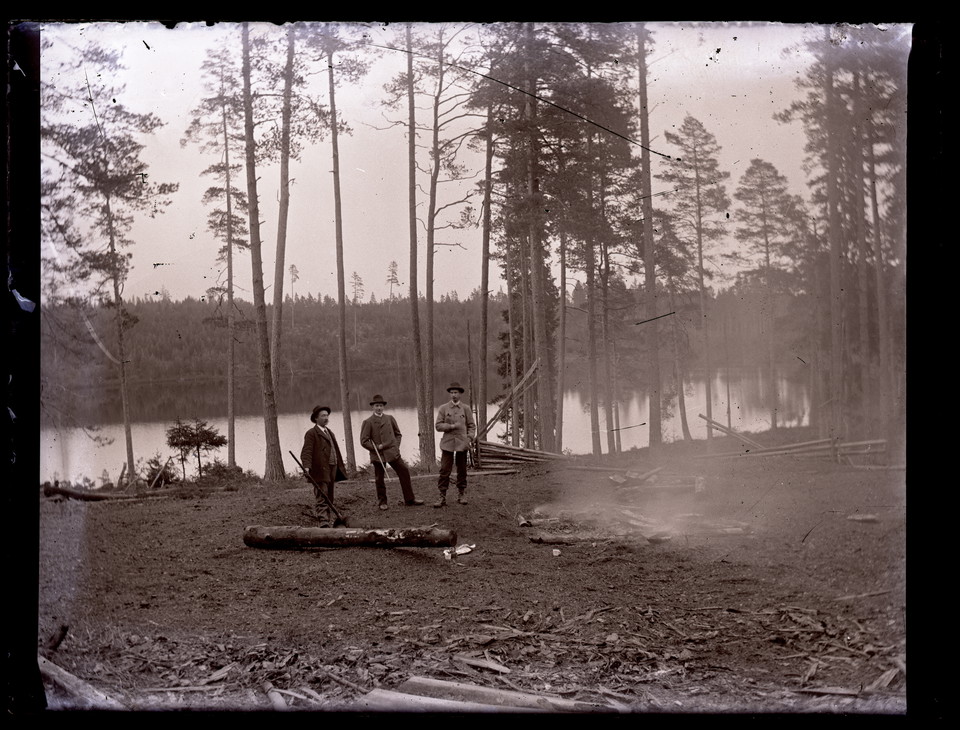
Skogsarbetare i Riddarhyttan från tidigt 1900-tal. Foto: Carl Ludvig Müntzing, Västmanlands läns museum
Skogsbrukets historia, Skinnskatteberg - Färnaleden
- Interessant sted
- Fotturer
- Informasjon
- Fylke: Västmanlands län
- 154.23 km fra deg
Handlinger
Beskrivelse
**The history of Swedish forestry
Besides being vital to the life of our planet's inhabitants in terms of photosynthesis and a basis for our ecosystem services, the forest has always played a central role in the lives of us northerners. The forest has been, and is, our home and an important economic resource for the whole country. Forestry is constantly changing and it is easier to understand where we are today by looking back at how it has looked in history.
**Hand power and horse power
Before the modernization of the 1950s, we managed forests by hand, using tools such as logging saws and felling axes. The timber was transported out of the forest in winter by horse and sledge, placed on the ice of frozen rivers, and in spring floated along the waterways to the sawmills on the coast. The timber was sawn into lumber and shipped out to Swedish and foreign ports.
**1903 Forestry Act
But the forest did not only provide timber. It was also a source of timber for forestry, where forest areas were burned to be used temporarily for growing grain and grazing, and for mining, where timber was charred in kilns to supply the blast furnaces with coal for roasting the ore, to smelt various metals from the rock. This practice required large amounts of forest. As the sawmill industry grew, a shortage of wood arose and it became a challenge to secure the supply of wood to forges and smelters. This led to the introduction of the 1903 Forestry Act, which was considered the world's first modern forestry law. It included the replanting of forests after felling to rebuild Sweden's forest stock. This was the start of a more structured approach to modern felling. And one of the centers of this development process was Skinnskatteberg.
**1948 Forestry Act
1948 saw the introduction of a new Forestry Act which, in addition to the obligation to regrow, also prescribed minimum permissible final felling ages and measures to protect growing forests from insect pests. The Act also regulated the maximum permissible area of bare ground and young forest for individual forest properties.
**Modernization of the 1950s
The 1950s saw the start of the modernization and streamlining of forestry, not least thanks to the increased availability of oil. Motorized tools and machines provided new opportunities and economic calculations showed that felling was the most profitable method of forestry. This eventually led to a more detailed Forestry Act in 1979.
**The 1979 Forestry Act
1979 also saw the introduction of the obligation to clear young forests, the obligation to thin and the obligation to fell low-producing forests. At this time, stand adaptation was also described in more detail. That is, different regrowth methods and which tree species are best used on different soils.
**Nature conservation in the 1980s
Up to this point in history, phenomena such as environmental considerations, clear-cutting and biodiversity have not had high priority in large-scale forestry. But in the 1980s, the topic of nature conservation began to appear more and more in forestry contexts.
**The change in the 1990s
With the 1993 Forestry Act and the introduction of the new forestry standard Forest Stewardship Council (FSC Sweden) in 1995, we begin to see a slow but steady introduction of more environmental considerations. 1998 saw the EU's first visionary forest strategy and more and more debates on forests and the environment begin to be heard.
**21st century clear-cutting methods
After the turn of the millennium, we see that more and more large landowners begin to apply clear-cutting methods in their forestry. 2009 also saw the Lisbon Treaty, which meant that the European Parliament gained greater power as a legislator, including when it comes to forestry.
**The 2010s
The Lübeck model from Germany in the 1990s is now beginning to be referred to more and more in the Swedish forestry debate on cut-free methods. Both society at large and the debate about Swedish forestry are becoming increasingly transparent, and journalists such as Maciej Zaremba are entering the debate. In 2013, the EU's forest strategy is updated and the Swedish Forest Agency highlights the benefits of adaptive forestry. At the same time, the demand for biomass is increasing in our quest for a fossil-free society.
**The 2020s
SLU Future Forests, a platform for interdisciplinary forest research, collaboration and research communication, is created in a collaboration between SLU, Umeå University and Skogforsk. The platform focuses on sustainable forestry in a broad sense. In the 2020s, the EU will also come up with a new biodiversity strategy, which today extends into the future with a focus on climate change and biodiversity.
**National Forest Program
Throughout history, the Swedish forest has contributed to solutions, not least in mining such as coal, as well as contributing to economic gains in the form of timber products. And with today's technology, the forest contributes more than ever to solutions for the future. To meet future needs, the government has decided on a national forest program. Since 2018, five focus areas with targets have been developed. These focus areas and associated goals will help to achieve the vision where the forest contributes to jobs, sustainable growth and the development of a growing bioeconomy.
The Swedish government has decided on a national forest strategy where the vision is:
"The forest, the green gold, will contribute to jobs and sustainable growth throughout the country and to the development of a growing bioeconomy."
To achieve the vision, five focus areas have been created within the national forest program.
- sustainable forestry with increased climate benefits.
- multiple use of forests for more jobs and sustainable growth throughout the country.
- world-class innovations and processed forest raw materials.
- Sustainable use and conservation of forests as a profile issue in Swedish international cooperation.
- a knowledge leap for sustainable forest management and conservation
As part of Västmanland's forest strategy 2030, this hiking trail you are currently visiting is a result of point number five above. SLU School of Forestry has coordinated this focus area within the trail development project. With the knowledge we spread along the Skinnskatteberg-Färna hiking trail, we want to broaden the knowledge of the forest and its multiple uses, both in industry and the individual's stays in the forest and land.
Aktiviteter og fasiliteter
- Fotturer
- Informasjon
- Interessant sted
Fakta
This sign is part of Skinnskatteberg - Färnaleden.
Through the project Ledutveckling Skinnskatteberg-Färna, Trails of Västmanland Expansion 2022-2024, with financial support from the Swedish Agency for Economic and Regional Growth, the trail has been improved and provided with information signs. Each information sign has its own point on the Nature Map where more facts about each topic are combined with links to further reading.
The project has been coordinated by Skinnskatteberg municipality in collaboration with SLU Skinnskatteberg as a knowledge partner with support from various local stakeholders and landowners. Jonas Vildmark Bushcraftcenter has through preparatory work, physical work on the trail and knowledge collection driven the work.
Kontakt
Adresse
Box 101, 739 22 Skinnskatteberg
E-postadresse
Veronica Dahlberg
Organisasjonens logotype
Jeg har vært her
Jeg ønsker å dra hit
Spørsmål og svar
Still et spørsmål til andre brukere av Naturkartan.
Omtaler
0 anmeldelser
- 5 :
- 4 :
- 3 :
- 2 :
- 1 :