
-
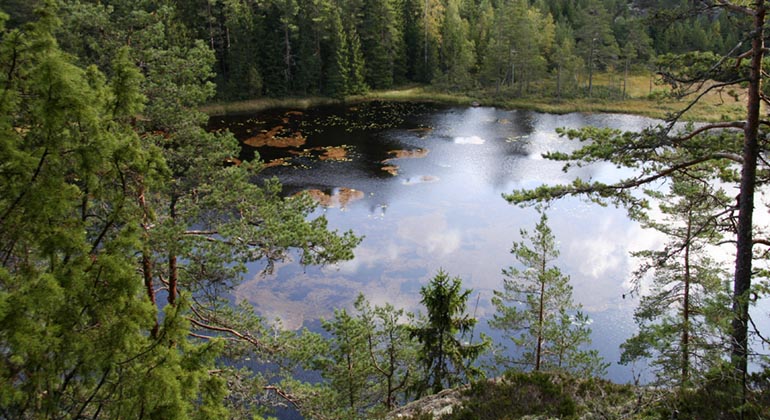
Utsikt över Rövarviken från Rövarbro skans.
Foto: Thomas Karlsson
Rövarbro skans, Naturreservat
- Naturreservat
- Fylke: Örebro län
Handlinger
Beskrivelse
The Rövarbro skans nature reserve consists of a forested hillside located in Kilsbergen, bounded by several mountain ridges to the north, west and east.
Heavy hike to nice views
Rövarbro skans is an imaginative place and it is easy to imagine that the robbers were here in the Middle Ages, lurking on transports that went between Närke and Värmland. The hike up to the top gives you lactic acid in your legs but is worth it when you see the view of Lake Lilla Noren far below.
Dead wood lives
This is a wild and distinctive forest and mountain area that is little affected by forest management measures. It has been forested for a long time and thus has a relatively long forest continuity. Due to its varied exposure, many gorges, cliffs and boulders, heavily shaded trees and the availability of dead wood in various stages of decomposition, it is of great value to ferns, mosses, lichens, fungi, insects and other animals.
Fussy lichen
The area is home to the spotted lichen, which is threatened by modern forestry. In our area, it usually grows on rock walls in sheltered, moist locations in natural forests. The area is a small but representative part of the Kilsberg terrain, which has been given national interest for nature conservation in national planning.
An ancient castle
The ancient castle in the center of the area is an ancient and legendary viewpoint in Kilsbergen. It was built during the Migration Period, has natural rock slopes as part of the fortification's protection to the north, east and west, and block walls built as protection to the south. The fortress is protected by the Cultural Environment Act. Large boulders and steep precipices fuel the imagination even more. An excursion destination at any time of year, preferably in the company of children.
Facts about ancient castles
Ancient castles fascinate people and there is something exciting and mysterious about them. What did they look like? What were they used for? Who used them? What era are they from?
Many ancient castles in Mälardalen
There are almost 2,000 ancient castles in the Nordic countries, and just over half of these are in Sweden. There are different types of ancient castles in different areas of Sweden, and the densest concentrations are in the Mälar region, along the west coast, in Östergötland and northern Småland. On Öland and Gotland there are also so-called lowland castles, which are quite different from those on the mainland.
The first researchers
Ancient castles have fascinated people over the centuries. The very first records of the country's ancient castles were made back in the 17th century. At that time, the main focus was on inventorying the location and appearance of castles. In the 1930s and onwards, the step was taken to start investigating the castles. The first archaeological investigations were carried out by archaeologists such as Ivar Schnell, Sten Anjou, Arthur Nordén and Mårten Stenberger.
What are the different types of castles?
Throughout history, ancient castles have been classified in different ways. The earliest is a pure description of what the ramparts look like. Are there one, two or three ramparts, and did they use rocky outcrops to build the castle? Then people started to take a little more interest in where the castles are located in nature. Are they built high up on a mountain? Or are they down in the lowlands? After that, people became more interested in their function. Is it possible that people sought shelter in the castle? Are there many ancient monuments nearby? Is the site close to waterways where people could keep a close eye on who was traveling across the water? Have they been used as burial sites or are they more of religious importance? Was the castle perhaps used for living in?
What were the castles used for?
It was long believed that all ancient castles were places of refuge during troubled times, especially during the Migration Period (400-550 AD). At that time, there was no thought that the castles could have been built for reasons other than external threats, and this was long believed. Today there are several researchers who have new theories about these ancient castles. Calling all places ancient castles is not quite right, but they are often registered as ancient castles in the Swedish National Heritage Board's ancient monuments register. Other names used are ramparts or enclosures. Many castles have been used as protection in times of unrest. Other castles have been used more for religious and cultic purposes. The sites are often located on high ground and have had a good view of the surroundings. It has been a natural vantage point used to look for signals in the landscape and from other ancient castles nearby. Whatever the reason for building the castles, they have been a significant feature of the landscape and have brought many people together.
Örebro County's ancient castles
There are 34 registered ancient castles in Örebro. Most of them are located at high altitude and overlook the surrounding areas. Some castles overlook several castles while others only look over to another castle. Many of the ancient castles are located in Kilsbergen along the edge and they all look out over Närkeslätten, for example Borgaresjö skansar, Tistaborg, Ullavi klint. They have not had the main contact with each other but have instead looked out over the plain and the ancient castles located on a band in the southern part of the plain area, for example Tarstaborg. These ancient castles in turn look back towards the ancient castles of Kilsbergen.
Aktiviteter og fasiliteter
- Naturreservat
Fakta
Municipality: Karlskoga
Established in: 1943 (domain reserve), 1996 (nature reserve)
Area: 3 hectares
Landowner: Sveaskog AB
Manager: County Administrative Board
Reserve creator: County Administrative Board
Veibeskrivelse
From E18 towards Karlskoga, turn off towards Norhammar after the exit towards Leken. Turn right immediately and follow the road for about 800 meters.
Forskrifter
In the nature reserve it is forbidden to:
- damage the soil or vegetation, for example by digging or picking flowers, lichens or wood fungi
- disturbing wildlife
- camping
- making fires
- putting up notices and signs
- driving motor vehicles or riding bicycles
- laying out marked trails or similar
Kontakt
E-postadresse
Organisasjonens logotype
Jeg har vært her 3


Jeg ønsker å dra hit 2
Spørsmål og svar
Still et spørsmål til andre brukere av Naturkartan.
Omtaler
1 anmeldelse
- 5 :
- 4 :
- 3 :
- 2 :
- 1 :

Vacker vy och fin gammal skog! Det kändes lite otäckt att gå på vissa ställen nu när det var blött, men det gick fortfarande bra att gå till toppen