
Tjärrännan
- Kulturelt miljø
- Fylke: Jönköpings län
- 236.89 km fra deg
Handlinger
Beskrivelse
Tar, an important commodity for the villages around Hökensås
From the 16th century onwards, tar was one of Sweden's biggest export products. Most of it came from the eastern half of the country (Finland), but large quantities were also produced in pine-dominated areas in present-day Sweden.
As shipbuilding in Europe grew, particularly in the 17th and 18th centuries, thousands of barrels of tar were shipped out from Swedish ports. Around the turn of the century 1800, the peak was reached with about 183,000 barrels of tar and the by-product pitch per year.
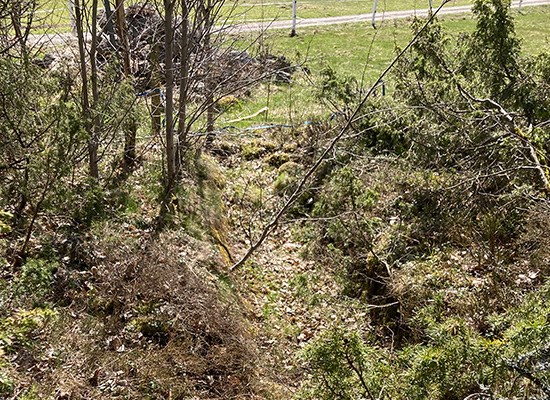
Tar was produced in a gutter according to the same principle as in a tar mile, with the difference that the shape of the mile was round while the gutter was oblong and located on a slope. The trench was dug out and the bottom trampled to make it as smooth as possible. The newly built tarred channel was then filled with densely packed small-cut pine. The wood used was mainly from pine stumps. When the trees were felled, the sapwood eventually rotted, and when the stumps were broken up, the coveted resin-rich heartwood remained, which was cut into smaller pieces before being stacked in the channel. The wood was covered with a thick layer of spruce brushwood and on top of this a layer of soil and peat. The gutter was lit at the top and when it caught fire this part was also sealed. But a hole was left and here the nozzle of a bellows was placed, which was used to give the burning just the right amount of oxygen and thus control the burning. As the gutter burned and collapsed from top to bottom, the bellows also moved downwards. At the bottom of the gutter, the running tar was collected in a vessel, such as a barrel, surrounded by stones that held it in place. A drain pipe led from the gutter to the barrel. When the gutter was demolished after the tar had been drained, large quantities of charcoal were also left behind. Tar charcoal was sought after and fetched a higher price than, for example, spleen charcoal. The tar gutters were used several times and eventually acquired the characteristic shining of tar at the bottom. The older and better used the tar gutters became, the better the yield. Old tar gutters, unlike newly laid tar gutters, could also produce tar quite soon after the start of burning. Depending on the size of the tar pit, burning could take around 3-6 days.
Tar burning was a secondary occupation that could provide the peasant households with a good income alongside agriculture. In Brandstorp parish, there are an unusually large number of tar pits registered in Fornsök, but we do not know how old they are. Archaeological investigations of tar gutters and tar pits can provide answers or documents that tell us about tar production in the villages around Hökensås. Perhaps the burning of tar was a local specialty in the area? Further research can show whether the tar was used in the towns and boat builders around Lake Vättern or whether it was exported to shipyards in Holland or England.
The tar gutter here has the number L1972:5250 in Fornsök It is about 10 meters long and just over half a meter deep. Solidified tar is visible at the edge. In the northern part there is a stone collection.
Aktiviteter og fasiliteter
- Kulturelt miljø
Veibeskrivelse
Directions
Continue from Lottes on the road about 150 meters to the southeast. There is a turnoff towards Kopparhult. On the right side of the road is a stone wall. Follow the stone wall on the forest side about 70 meters in until you reach the tar valley which is located on the slope down to the road.
Center coordinates (SWEREF 99 TM)
N 6443720, E 449789
Kontakt
E-postadresse
Kultur- och fritidsförvaltningen i Habo kommun
Organisasjonens logotype

Jeg har vært her
Jeg ønsker å dra hit
Spørsmål og svar
Still et spørsmål til andre brukere av Naturkartan.
Omtaler
0 anmeldelser
- 5 :
- 4 :
- 3 :
- 2 :
- 1 :