
-
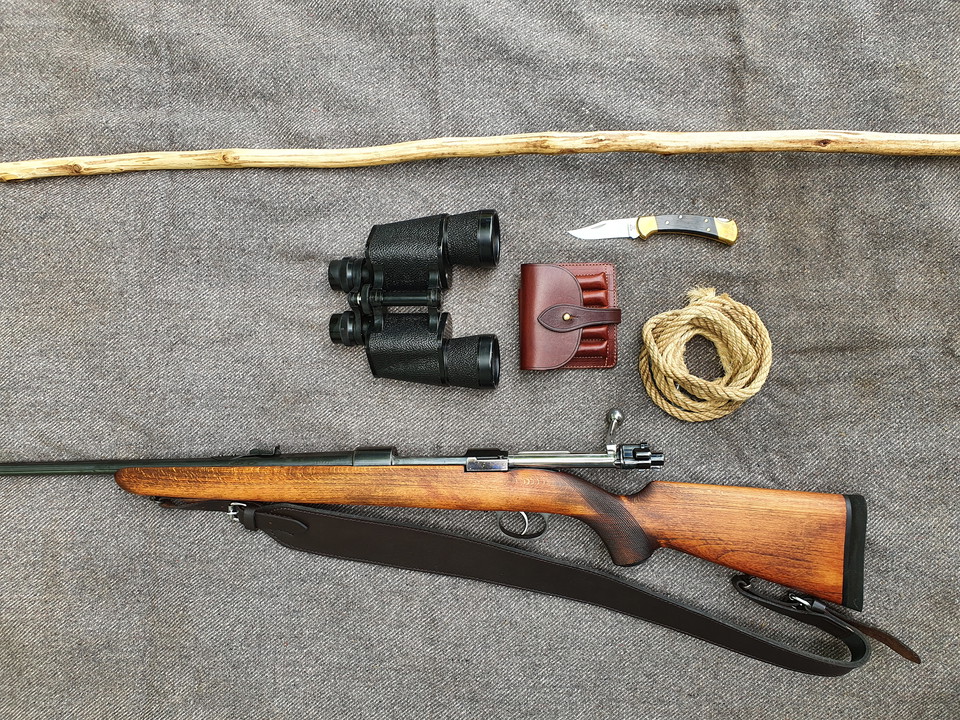
Utrustning för en viltförvaltare. Foto: Jonas Landolsi
Viltförvaltning, Skinnskatteberg - Färnaleden
- Point of interest
- Hiking
- County: Västmanlands län
- 154.87 km away from you
Actions
Description
Wildlife management
Wildlife management refers to the work done to ensure that the wild animals that occur naturally in Sweden exist in the long term in viable and balanced populations, as part of Sweden's fauna. The wildlife population plays an important role in forests and land and, if managed correctly and respectfully, is also a renewable resource. Hunting is part of game management, a tool for regulating game populations to balance and for utilizing the resource that game also represents in the form of game meat, for example. Wildlife management is another tool in wildlife management, where wildlife is cared for, including through possible supplementary feeding and the creation of favorable environments for wildlife to live in. Wildlife management is a very broad topic that is closely intertwined with forest management and environmental work. Swedish wildlife management also offers experiences, social networks and contributes to public health.
The structure of Swedish wildlife management
Swedish wildlife management is strictly controlled by various organizations that rely on jointly agreed laws and regulations. The aim is to achieve safe and effective wildlife management that strives for a healthy balance in forests and land, for healthy wildlife populations. Hierarchically, the overall rules for the country's wildlife management are decided within the EU, Parliament and Government. The decision-makers are assisted by organizations such as the Swedish Environmental Protection Agency and the County Administrative Board. The County Administrative Board, in turn, consults with Sweden's various game management areas, which consist of several local hunting teams. The hunting teams in turn consist of hunters who, through experience and a hunting license, have access to a specific area's hunting rights. On the land along this trail, the landowners have, for a fee, granted hunting rights to the respective hunting teams, which are thus responsible for game management on the land in question. Hunters and landowners regularly inventory the game and draw up a long-term game management plan which is agreed with the County Administrative Board. The management plan is continuously evaluated and updated during the course of the long-term work. Swedish game management thus consists of a large number of decision-making bodies and regulations based on current research, management history and laws. The individual hunter plays an important role throughout this democratic decision-making chain.
**Hunting associations
In Sweden today we have three major hunting associations. These are the Swedish Hunters' Association, founded in 1830, the Swedish Hunters' Federation, founded in 1938, and the Swedish Hunters' Association, founded in 2021. These organizations work for their members and the good of game management. Decision-makers often seek advice from the associations in connection with decisions, and the associations also have practical commitments in the form of assignments given by decision-makers. Some examples of cooperation within the various wildlife management organizations are searches in connection with wildlife accidents in traffic, work on invasive species and public support via each county's Wildlife Management Delegation.
Wildlife management along this route
The hiking trail you are currently walking stretches across several local hunting teams' hunting grounds. North of road 233, Skärsjöns Jaktlag has been responsible for game management since the 1950s. South of road 233, Lapplands Jaktlag and Bjurforsens Jaktlag are among those responsible for game management. The various hunting teams are run like associations with associated boards, statutes, meetings, common tasks and goals. In addition to the responsibility of managing the land's game in a sustainable way, the hunting teams also play an important social role in the locality, as cooperation between local people is a prerequisite for successful game management. Examples of common game species managed here in the Skinnskatteberg area are small game such as hares, red foxes, forest birds, beavers and deer. And examples of big game are wild boar, red deer and elk. Where this information sign is located, you may hear regular rifle shots in the distance. If you do, it is practice shooting at Gunnilbo Hunting and Shooting Club's shooting range. It's important that our active hunters are also good marksmen. That's why all the shooting ranges in the country are an important part of the hunters' constant quest to be able to deliver safe, effective and ethically correct shots during the hunt.
**Hunting hours
The local hunting seasons here in Skinnskatteberg indicate when game management via regular hunting may be conducted for the game in question. Below are some common hunting times.
Moose 8/10-31/1
Red deer 16/8-28/2
Wild boar 1/7-30/6
Roe deer 1/5-15/6, 1/9-31/1
Red fox 1/8-15/3
Badger 1/8-31/1
Beaver 1/10-10/5
Arctic hare and brown hare 1/9-28/2
Capercaillie and Black Grouse 8/25-15/2
As a hiker along this trail, it is both interesting and necessary to be aware of the area's hunting and game management in order to show consideration during your visit. For safety reasons, it's a good idea to wear brightly colored clothing during hunting season so you can be seen in the wild. And if you meet a hunter, don't be afraid to quietly say hello and ask how the hunt is going. Local hunting teams are usually most active during the first week of the moose hunt (around 8/10-15/10) and the following weekends until 31/1.
**Dogs in the wild
There are many different hunting methods that are allowed on our country's 60 or so huntable game species. The most common methods today are hunting with loose dogs. The uniquely Swedish stray dog hunt is today classified as a Swedish cultural heritage. If you come across a loose working hunting dog, usually equipped with a varsity vest and GPS collar, you should not disturb the dog but let it continue working. If the hunting dog stops working, or if you want to get in touch with the handler, there is usually a phone number on the vest or collar. During the spring and summer, we all need to be particularly considerate of wildlife, as this is the time when many of its young are born in the woods and fields. These range from baby birds and rabbit fawns to deer fawns and elk calves. For this reason, we have a law that says dogs must be prevented from running loose in the fields during the period March 1 to August 20. Both the hunting dog and the pet dog must then stay in direct contact with their owner/handler while wandering. And for most dogs, this means that they need to be kept on a leash. There are exceptions, however, when it comes to tracking and protection hunting, for example. This hiking trail runs partly through the Lapland nature reserve and within its boundaries it is forbidden all year round to bring an unleashed pet dog or other loose pet.
Activities And Facilities
- Hiking
- Point of interest
Facts
Den här skylten är en del av Skinnskatteberg - Färnaleden.
Genom projektet Ledutveckling Skinnskatteberg-Färna, Trails of Västmanland Expansion 2022-2024, med ekonomiskt stöd från Tillväxtverket, har leden förbättrats och försetts med informationsskyltar. Varje informationsskylt har sin egen punkt på Naturkartan där mer fakta kring varje ämne samsas med länkar till ytterligare läsning.
Projektet har samordnats av Skinnskattebergs kommun i samarbete med SLU Skinnskatteberg som kunskapspartner med stöd från olika lokala intressenter och markägare. Jonas Vildmark Bushcraftcenter har genom förarbete, fysiskt arbete på leden och kunskapsinhämtning drivit arbetet.
Contact
Address
Box 101, 739 22 Skinnskatteberg
Email address
Veronica Dahlberg
Organization logotype

Please be aware that some of these texts have been automatically translated.
I’ve been here
I want to go here
Questions & Answers
Ask a question to other Naturkartan users.
Reviews
0 reviews
- 5 :
- 4 :
- 3 :
- 2 :
- 1 :