
-
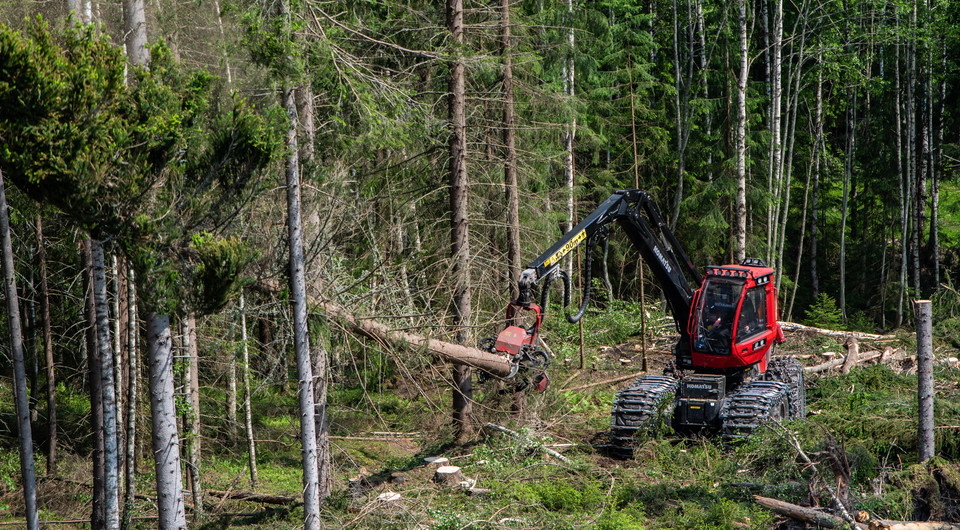
Skördare Komatsu. Foto: Jean-Philippe Guay
Trakthyggesbruk, Skinnskatteberg - Färnaleden
- Point of interest
- Hiking
- Information
- County: Västmanlands län
- 154.67 km away from you
Actions
Description
Funnel logging
The idea of felling is that the management of the forest should deliver wood at a steady rate over time. This applies at property, regional and national level. This means that a forest owner's property is divided into plots that are harvested successively over a number of years. Depending on ownership, a plot can range from a few hectares to tens of hectares or more. One hectare is 10 000 square meters, which corresponds to an area of 100 x 100 meters. Each individual plot is harvested when the forest is considered economically mature. The average time it takes for the forest on the property to reach harvesting maturity is called the rotation time. In our part of Bergslagen, the length of rotation times has decreased from around 80-100 years a few decades ago to the current 60-80 years. There are several reasons for this, for example, replanting after felling has been developed, with the cultivated plants becoming more effective over the years. The aim of felling is to achieve timber-rich, relatively homogeneous forest stands with a small diameter spread of tree trunks during regeneration felling, also known as final felling.
History of coppicing
Felling was developed in 1700 in what is now Germany on large forest estates. In Sweden, there was a shortage of timber in large areas, especially where there was mining, as here in Skinnskatteberg. These problems were discussed in the Riksdag in the latter part of the 18th century and onwards. Forestry education was started in Bysala south of Färna by the Brukssociet in 1848. In the mill forests, we had a period of felling in the latter part of the 19th century. In the early 1900s, many people advocated other forms of felling, and felling declined in scope. The World Wars and the difficulties of supplying the growing cities' need for imported coal for heating and transportation created an increased need for wood for energy purposes. The amount of timber required led to large-scale logging and the widespread adoption of felling. Forest policy was designed so that felling and its measures became normative. For a time, forest management was regulated in detail so that several measures became mandatory. But after the most recent revision of the Forestry Act, the field opened up for different ways of managing forests.
**The management cycle of felling
During a rotation period, a number of measures occur. These are:
Regrowth planning means that the next regeneration felling and reforestation are planned. This also determines what the next forest generation will look like in terms of tree species distribution etc. Within the felling area, so-called stand adaptation takes place, which means that variations can be promoted within the future stand. An example of this is that self-seeded silver birch can be the tree species of choice in damp areas.
**Soil preparation facilitates regeneration work and increases the survival of tree seedlings.
Plant establishment can be done in different ways. These are: planting (pine and spruce) or seed sowing (pine) or self-regeneration under seed trees (pine). A method that also occurs in frost-sensitive areas is to use overgrown birch to establish a spruce stand that can consist of planted seedlings but also consist of self-sown spruce.
**Clearing means that the number of seedlings or stems is regulated according to the conditions of the stand. Clearing takes place at tree heights below about 4 meters. Fertile soils can support more stems and higher timber volumes than weaker soils can. During clearing, unwanted stems are removed but the timber, which is very small, is left in place to decompose.
Thinning involves successive thinning of the stand so that the remaining stems can develop and become coarser. The timber is recovered as pulpwood or small timber.
Rejuvenation felling means that the majority of the trees are felled. Most of the timber becomes sawlogs that are transported to sawmills for processing. The thinnings, also known as pulpwood, go to pulp mills for chipping and cooking. At a later stage, the part of the logs from the sawmills that has not been turned into planks or boards also goes there. Of our annual timber harvest, about half of the wood will become planks and boards, while an equal amount will become raw material for the pulp and fiber industry.
**The economics of timber harvesting
Felling, with its high timber concentrations and relatively small dimensional spread between trees, has benefited from technological development, which in turn has been influenced by the problems created by mechanization. Unlike many competitor countries in the market, Swedish forestry is not dependent on subsidies. Rationalization has historically meant that costs have been cut continuously by about 2% per year. This has been achieved gradually through technological innovation or changes in working methods. Raw material prices, on the other hand, have not risen as much as might have been hoped. Timber price lists are a major determinant of how forests are managed. Very large logs can now pay less per cubic meter than the slightly smaller logs that sawmills want. When the diameter of the tree trunk at breast height exceeds 40 cm, they are close to the dimensions where prices are negatively affected due to the technical logistics of sawmills.
**The environmental impact of felling
Felling has a very strong impact on the environment. The felling phase involves a radical increase in solar radiation, with some species benefiting and others suffering. Examples of species that often become established in regeneration areas are grasses and, as a result, grazing animals. The presence of lingonberries and bilberries is favored on many lands. Populations of voles and their predators increase in clearings. Shade-loving organisms are generally disfavored, including freshwater mosses and many vascular plants. There are species that require long continuity of shading to establish themselves. Other species, including decomposers, benefit from sun exposure.
For a long time, until fairly recently, problems relating to forest water were taken rather lightly. This is not just about watercourses but also about groundwater and its chemistry. In the first half of the 20th century, forest land was cleared to increase timber production. The forestry road network expanded rapidly and environmental aspects were not always taken into account. These shortcomings are now being addressed, but much remains to be done.
In the years following the end of the Second World War, the public, which had become increasingly urbanized in the 20th century, was given the opportunity to travel in the countryside by private car. Interest in the environment began to grow and several debates on forestry practices emerged in the media. Non-profit organizations gained an influx of members. Examples of topics of interest were: the clear-cutting debate (1970s), the debate on the use of hormone sprays for chemical leaf control (1980s), afforestation of former meadows and pastures (1980s) and concerns about forest death due to acidification (1990s). Forestry and agriculture's work on breeding (genetic modification) of seed and planting material has been ventilated in the early 2000s. There are other areas of conflict. Perhaps the most recent is the role of forests in long-term carbon storage. Some would argue that the harvesting phase itself is the problem, while others point out that the total wood supply in the country has doubled in the last hundred years and that this is linked to the use of felling.
Activities And Facilities
- Hiking
- Information
- Point of interest
Facts
Den här skylten är en del av Skinnskatteberg - Färnaleden.
Genom projektet Ledutveckling Skinnskatteberg-Färna, Trails of Västmanland Expansion 2022-2024, med ekonomiskt stöd från Tillväxtverket, har leden förbättrats och försetts med informationsskyltar. Varje informationsskylt har sin egen punkt på Naturkartan där mer fakta kring varje ämne samsas med länkar till ytterligare läsning.
Projektet har samordnats av Skinnskattebergs kommun i samarbete med SLU Skinnskatteberg som kunskapspartner med stöd från olika lokala intressenter och markägare. Jonas Vildmark Bushcraftcenter har genom förarbete, fysiskt arbete på leden och kunskapsinhämtning drivit arbetet.
Contact
Address
Box 101, 739 22 Skinnskatteberg
Email address
Veronica Dahlberg
Organization logotype
Please be aware that some of these texts have been automatically translated.
I’ve been here
I want to go here
Questions & Answers
Ask a question to other Naturkartan users.
Reviews
0 reviews
- 5 :
- 4 :
- 3 :
- 2 :
- 1 :