-
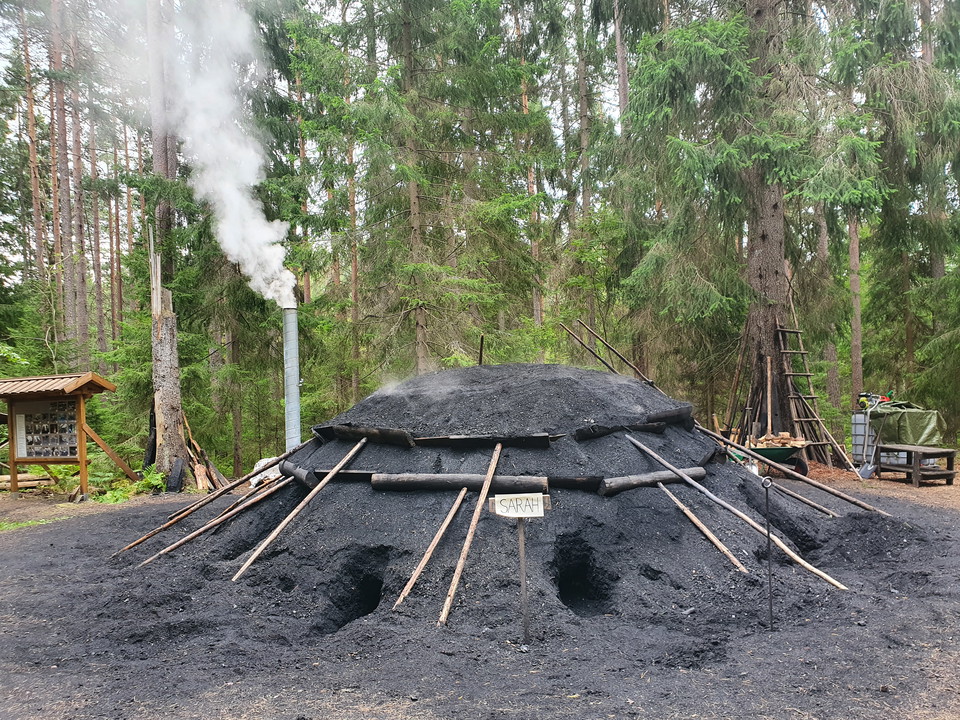
Kolmila. Foto: Jonas Landolsi
Bergsbruk, Skinnskatteberg - Färnaleden
- Point of interest
- Hiking
- County: Västmanlands län
- 161.45 km away from you
Actions
Description
Mining
Mining refers to the exploitation of rock. Rock rich in minerals and elements such as Iron, Copper, Cerium and the like can be mined and processed to extract elements. These elements are, among other things, important components of today's metals with which we can make things like tools, cars, buildings, electronics and batteries.
**Mined metals
Bergslag was originally the name given to the group of miners in an area who had mining privileges (the right to mine). Over time, the name came to be understood as the whole region where these miners worked. After deposits of ore bodies were discovered in the area around Skinnskatteberg, then known as Skinsäckaberg, Queen Margaret granted privileges to the 'Miners of Skinsäckaberg' in 1366. Mining of land and mines began to reach the iron and other metals down in the rock. One of the older mines in the area is Korphyttan, which is mentioned in the land register as early as 1552. Here in the municipality we also have one of the world's most mineral-rich areas, the Bastnäs minefield, where the element Cerium was first documented. Both of these mines are located in the municipality of Riddarhyttan.
Bergslagen was organized by the Bergskollegium, a central agency in Sweden that was active between 1637 and 1857.
**Mining
Today, modern mining is carried out by mining or quarrying with advanced rock drilling machines, dynamite, excavators and dump trucks. But hundreds of years ago, before the use of gunpowder, the methods were more primitive. A common mining method then was the 'tilting' method, whereby a fire was lit at the rock face of the mine. The heat and temperature changes created cracks in the rock, which could be chopped off piece by piece by hand with a spike, sledge hammer and pick. Sometimes cooling water was also used to speed up the temperature changes in the rock. Mining at this time was very physically demanding and risky work, not least because of the risk of rock falls and the formation of gas in the mine passages.
Cooling
In order to melt the iron out of the broken rock, so that iron ingots could be cast, blast furnaces were built at the county's smelters to roast the ore. The large furnaces were heated by large quantities of charcoal, which had to be constantly produced on site. Here the forest played a crucial role. Large quantities of timber were used for the mining industry, which also contributed to the development of felling (large clearings and reforestation) in the area. Coal was produced by hard-working miners and charcoal burners who felled trees and piled timber and firewood tightly together in charcoal kilns. The wood was covered with Stybb (a mixture of charcoal particles and sandy soil) so that the wood would char slowly in a controlled environment, and not just burn up. The oxygen-poor burning resulted in charcoal after days of kilning. The charring process was demanding as the mila, after construction and lighting, needed to be monitored around the clock to prevent the mila from striking (igniting with an open flame). After the mile was demolished and the coal cooled down, it was transported to the blast furnace's large coal house to be used as fuel in the blast furnaces.
**Coal bunkers
All the coal bunkers that can be found today in these woodlands testify to how extensive coal mining was during the heyday of mining here in Bergslagen. This information sign is placed at a coal seam, where you can see the remains of a coal seam. A coal bed is recognized by its usually round surface of between 5-15 meters in diameter, which formed the base of a resmila. It is not uncommon for young spruce trees to grow densely within the coal bed. There were also so-called recumbent mites, which result in a different shape of the coal bed. But the resmil was the most common variant in this area. Large parts of the forest were felled to produce coal for the blast furnaces, and the coal mines were scattered almost everywhere in the forests. Each mila was often accompanied by a charcoal hut where the charcoal burners lived while guarding the mila.
**Mining in the area today
The last mine in the municipality to close down was the Bäcke mine in Riddarhyttan in 1979. Today, all of Skinnskatteberg's mines, with their associated ancient buildings, are instead a fascinating cultural heritage. Today, there is no large-scale mining in the area, but instead there are a number of cultural-historical experiences to enjoy in these beautifully rustic environments, such as guided tours, art exhibitions and concerts. From time to time, the area is visited by international operators looking for potential mineral deposits to exploit. But so far, these modern exploration activities have not led to any resurgence of mining here in Skinnskatteberg. Today, the Bergsstaten, a special decision-making body within the Swedish governmental administrative authority, the Geological Survey of Sweden (SGU), is in charge of handling matters related to mineral exploration and extraction in the country.
**Coal village coal mine
The tradition, knowledge and craft of charcoal smelting is passed on today through small-scale charcoal production. Here in Skinnskatteberg, a charcoal kiln has been built and lit in the traditional way in Kolarbyn every year since 2007. This appreciated and well-attended experience can also be part of the SLU School of Forestry's students through a college credit course in charcoal making and forest history. Together with our local enthusiasts, the students build a mila in Kolarbyn, which is traditionally lit every year in mid-August. After a number of days of tending the mila, the mila is demolished and the charcoal is used by the locals during late summer's peaceful barbecue evenings.
Please visit the Kolar Village mila, inside the Kolar Village Eco-Lodge, to take note of the information signs about miling that are there. However, please respect that there are booked guests inside the Kolarbyn Eco-Lodge who are currently enjoying the silence and nature.
Activities And Facilities
- Hiking
- Point of interest
Facts
Den här skylten är en del av Skinnskatteberg - Färnaleden.
Genom projektet Ledutveckling Skinnskatteberg-Färna, Trails of Västmanland Expansion 2022-2024, med ekonomiskt stöd från Tillväxtverket, har leden förbättrats och försetts med informationsskyltar. Varje informationsskylt har sin egen punkt på Naturkartan där mer fakta kring varje ämne samsas med länkar till ytterligare läsning.
Projektet har samordnats av Skinnskattebergs kommun i samarbete med SLU Skinnskatteberg som kunskapspartner med stöd från olika lokala intressenter och markägare. Jonas Vildmark Bushcraftcenter har genom förarbete, fysiskt arbete på leden och kunskapsinhämtning drivit arbetet.
Contact
Address
Box 101, 739 22 Skinnskatteberg
Email address
Veronica Dahlberg
Organization logotype
Please be aware that some of these texts have been automatically translated.
I’ve been here
I want to go here
Questions & Answers
Ask a question to other Naturkartan users.
Reviews
0 reviews
- 5 :
- 4 :
- 3 :
- 2 :
- 1 :