
-
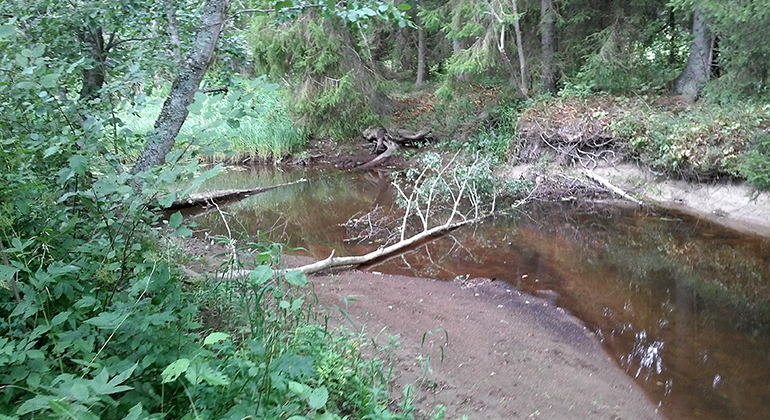
Trösälven.
Photo: Daniel Bergdahl -
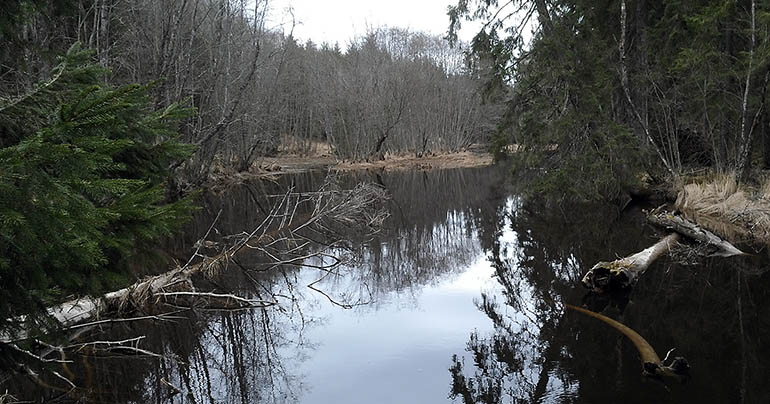
Trösälvens södra del.
Photo: Mattias Sterner -
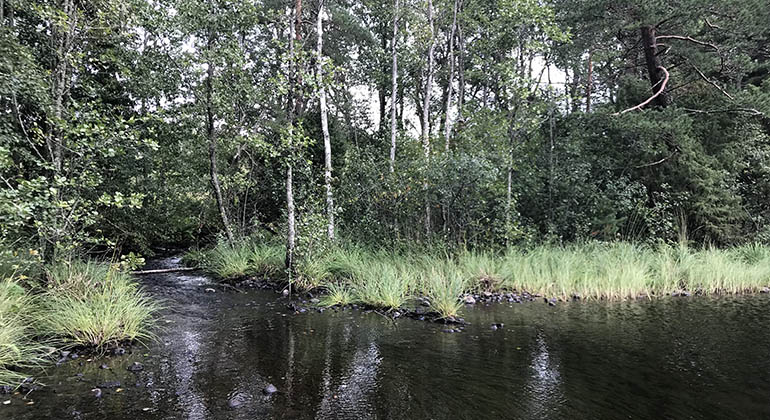
Trösälven vid Hållsjöhyttan.
Photo: Mattias Sterner
Trösälven, Naturreservat
- Nature reserve
- County: Örebro län
Actions
Description
The nature reserve protects parts of the Trösälven river and adjacent old forest and wetlands. The river contains one of the county's largest populations of river pearl mussels. At the northern end there are remains of one of Bergslagen's many ironworks, Hållsjöhyttan. There are no marked trails in the reserve, but from the parking lot along the road you can experience a nice stretch of the Trösälven river and the remains of Hållsjöhyttan. Out on the headland at the river's outlet in Hållsjön there is a nice picnic area.
Unusually pristine watercourse
The part of the Trösälven watercourse that is part of the nature reserve has retained much of its natural, meandering course. Nor has it been cleared of stones to any great extent. This is an unusual sight in today's landscape, where most watercourses have been both straightened and cleared to facilitate agriculture and forestry. It is therefore not surprising that we find one of the county's largest populations of the endangered river pearl mussel and its dear companion the trout here. Rare fish such as the stone loach and burbot also swim here. What they all have in common is that they require good water quality and that there are plenty of deciduous and dead trees next to the river. Rocks and boulders on the river bottom create variation in the water currents. Fallen trees in the water provide shelter for fish and bugs, but also food for various insects that in turn become food for fish. It may be possible to implement restoration measures in the future to further improve the aquatic environment for the threatened species river pearl mussel and trout.
Mussels dependent on trout
The rare river pearl mussel is known for its pearls, which it can form in the shell around grains of sand or tiny parasites that shed. The mussel depends on the fish trout for its reproduction. The mussel's tiny larvae attach themselves to the gills of the trout and live there as parasites for around 10 months. The tiny larvae then develop into a small, tiny mussel and let go to bury themselves on the river bottom. After 15-20 years, the mussel is sexually mature and can reproduce. The oldest river pearl mussel found in Sweden was 280 years old.
Species of the forest
The river is bordered by both species-rich forest areas and large wetlands. Conifers dominate, although there are also plenty of deciduous trees. The forest takes care of itself and the trees live and die at their own pace. Here we find discerning species that cannot survive in modern managed forests, such as the rare twig lichen and the small brown-powdered needle lichen. Dead tree trunks are home to the wood bumblebee, the border tick and the flesh tick. Bring a magnifying glass if you want to explore the many exciting lichens and mosses in the forest.
Hållsjöhyttan
The river's rushing waters have long been the lifeblood of the area. Iron has been produced in Hållsjöhyttan for over 200 years. For a long time, the team working at Hållsjöhyttan was the largest in Karlskoga Bergslag. The smelter was built next to the river's inlet at Hållsjön in 1655. Today, only a smelter ruin and piles of slag remain at the site. Plenty of slag is also found in the river and along the banks. A little further down the river, just outside the reserve at Hållsjötorp, there has been a mill since at least the 1660s. The current mill building was in operation until the 2000s.
Activities And Facilities
- Nature reserve
Facts
Municipality: Karlskoga
Decision year: 2019
Area: 136 hectares, of which 8 hectares are watercourses
Landowners: State and private
Reserve creator: County Administrative Board
Reserve manager: County Administrative Board
Directions
The Trösälven nature reserve is located about 8 kilometers north of Karlskoga, east of Kedjeåsen and Kärne.
Regulations
In the nature reserve it is forbidden to:
- drill, hack, blast, dig, carve, paint or otherwise damage rock, the earth's surface, stone or to move or remove stone,
- drive a motorized vehicle other than on an existing road
- felling, removing or otherwise damaging dead standing or fallen trees and bushes
- set fire to them
- fishing with nets,
- damage vegetation in general, for example by digging up plants such as rice, grass, herbs, mosses or lichens; the ban does not apply to berry, mushroom and flower picking for domestic use,
- deliberately disturbing wildlife other than what normally occurs when hunting and fishing,
- without the permission of the County Administrative Board, set up a permanent board, sign, poster or make tracks,
- without the permission of the County Administrative Board, use the area for organized competitions or exercises, camp activities or similar,
- without the permission of the County Administrative Board, carry out inventories or other scientific studies involving the collection or marking of plants and animals, drive a motorized vehicle off-road, erect temporary facilities or similar.
Contact
Email address
Organization logotype

Please be aware that some of these texts have been automatically translated.
I’ve been here
I want to go here
Questions & Answers
Ask a question to other Naturkartan users.
Reviews
0 reviews
- 5 :
- 4 :
- 3 :
- 2 :
- 1 :