
-
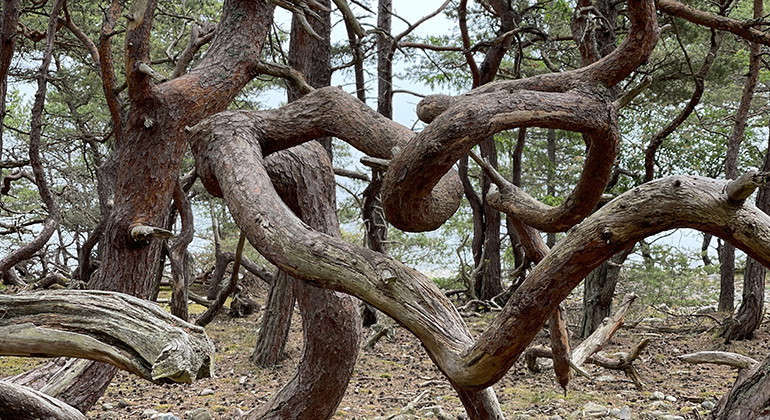
Photo: Stina Nilsson -
Fotograf: Anna Lindberg
Photo: Anna Lindberg -
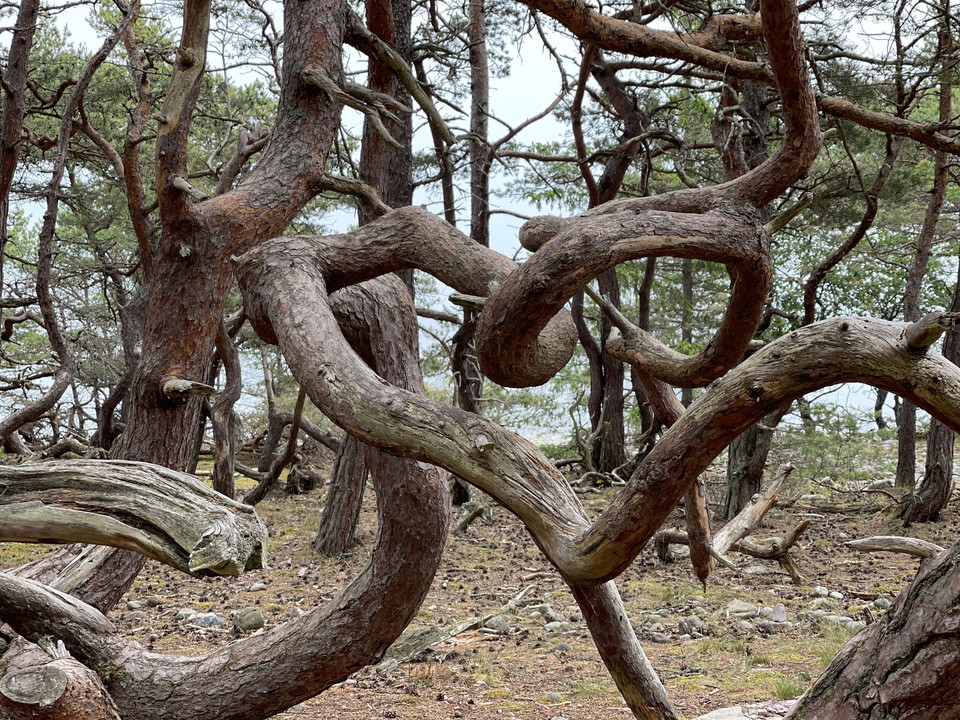
Foto: Stina Nilsson
Trollskogen, Naturreservat
- Nature reserve
- County: Kalmar län och Öland
Actions
Description
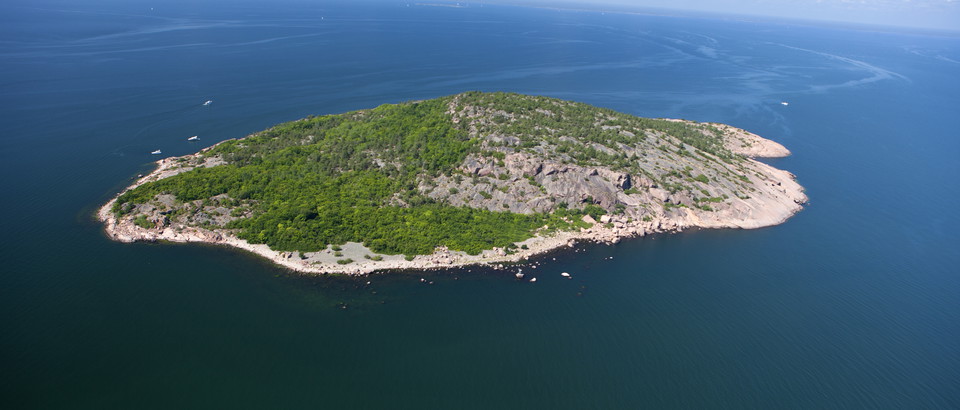
Trollskogen really lives up to its name. Here you walk through old pine forest with storm-turned trees. Here and there are mighty oaks covered in ivy. Along the sea there are both barren shingle beaches and lush beach meadows. Many unusual plants, animals and fungi live in this unique nature. The reserve is located on Öland's northeasternmost cape and is part of Ekopark Böda. Trollskogen is one of Öland's most visited nature areas.
Shaped forest
The reserve's pine forest has been shaped by man. The local inhabitants used to collect firewood and timber here and graze their animals in the summer. At that time, the forest was sparser than it is today. The forest is also characterized by its exposed location. The storm-turned pines are one of the reserve's hallmarks.
Udden oaks
As you walk through Trollskogen, you will see several large oaks with deeply furrowed bark. These old trees are very valuable as they are home to many insects, fungi, lichens and mosses. Among the inhabitants of the oaks, there are several that are endangered, as there is a shortage of old, large oaks nowadays.
Coast of contrasts
On the eastern side of the cape you walk on barren shingle beaches. Some of the stones have been transported here by the ice sheet, others come from the island's bedrock. All have been ground round by the constant movement of the waves. If you go over to the west side, you walk instead on lush, grazed beach meadows. A paradise for waders and other birds. In the summer, colorful butterflies flutter between all the flowers on the beach.
Diversity
The reserve is home to a wealth of species. How about around 300 different species of fungi and 155 different species of lichen? The old trees are home to insects, fungi, lichens and mosses. They are home to many threatened and rare species, including the lichen noble crown lichen, wood spike and short parasitic spike. Pine needles grow on old pines. These fungi are picky and will not grow on pines younger than 150 years! Among the insects, there are exciting species such as the relict beetle, the giant snapdragon, the black ox and the pine processionary moth. In May and June, there are plenty of linden blossoms in some parts of the forest, and the more unusual vascular plants in Trollskogen include thorny corm, yarrow and Baltic wormwood. The bird fauna is fairly typical of a mixed forest, but it is particularly pleasing that there are plenty of lesser crossbills and, for a few years now, several pairs of nesting fire-crowned kingfishers. The location of the cape also often attracts rarities, especially in the fall.
Nature you must not miss
Trolleken - is Öland's oldest oak with its 800 - 900 years. There are several old oaks in the forest. Over 1,000 different species live in, on and off a large, old oak.
Hjerteskeppet - South of the headland is also the mythical Hjerteskeppet. A depression in the ground that is about 25 x 80 meters in size. Legend has it that a ship ran aground and then became overgrown with grass. But now it is known that it is a dead ice pit, i.e. a place where a piece of the ice sheet has remained and melted for a long time and therefore left a depression behind. At the bottom of the depression is a well that had fresh water. The local people did not dare to let their cows drink the water because they thought the place was cursed.
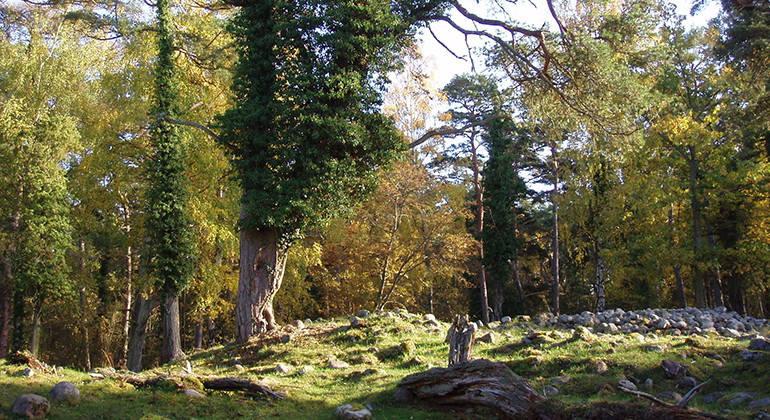
The Wallflower - meanders across the ground and up the trees in the Troll Forest. It is not a parasite that deliberately kills what it climbs on, but uses other trees to get up towards the light. It is a so-called epiphyte. The ivy has its own root system and takes its nutrients from the soil. It is easy to think that there are two different types of ivy. The leaves most commonly associated with ivy are the slightly triangular leaves, but when the ivy is 8 - 10 years old, branches with oblong leaves grow out. It is only now that the ivy starts to flower. The ivy is a bit contrary to other plants - it flowers in the fall and its blue-black berries ripen just in time for spring! On windless, warm fall days in September/October, you can hear the buzz of all the insects that seek out the flowers and the sweet nectar scent is felt in the air. Most have recolonized their host trees in the last 50 years - during the cold war winters of the 1940s, most of the stock froze. But some ivy trees in the forest are over 70 years old.
Storm cap - The pines in the north-easternmost part of Troll Forest have been exposed to the elements. They clearly show the impact of the wind when you see them winding and crawling along the ground.
**Kolyrka - as well as being a great place to have a coffee, you can also find a lot of interesting things in these sandy lands. Here, if you look carefully, you can find ant lions. Look for their traps in the bare sand. There are also several species of the mushroom genus earthstars growing here, which are truly beautiful.
Knyssla - out at the knyssla jetty you can lie on your stomach and look down into the water. Maybe you'll see sand mussels, bladderwrack and eelgrass? If you're lucky, you'll spot the seaweed snail, our own seahorse that lives among the eelgrass!
The shingle beach - along the eastern coast of Trollskogen, the beach is made up of rounded sandstone and granite rocks. When the waves wash over the stones, they make a "clattering" sound - this is why they are called shingle fields. These can be found both along the shore and up among the trees. It is difficult for plants to get a foothold among the rocks, which is why they are often left as 'shingle squares'.
**The shingle beach is home to the beautiful and highly resistant herb vetch. It was used in the past to produce the color blue. It is the yellow seeds that give an intense blue color when prepared.
Cultural and historical sights
There are around 15 burial cairns and stone circles in Trollskogen. The Iron Age graves are some of the oldest remains in the forest. The Iron Age lasted from 500 BC to 1050 AD. The burial cairns in the forest are of two different types: burial cairns with an arched profile and stone circles with a flat profile. They are dated to around 800 AD. In recent years, several new boat graves, a processional route and the remains of what is thought to be a chapel have been found.
To the south, a stone wall about 230 meters long runs through the forest. Until a few years ago, it was thought to be a hunting wall with the same function as the one on southern Öland and dating back to the days of Johan III (1568 - 1592). With new research, a completely different history has begun to emerge for Trollskogen. The wall is much older than previously thought and may have had a completely different purpose. We will update the information here with more exciting facts soon.
At the far end of the headland, some way into the forest, there are a number of entrenchments, smaller stone walls, which were used for defense purposes. In the 15th century, Örboviken (now Grankullaviken) was an important naval base from which a large part of the central Baltic Sea was controlled. The forts were used as protection against cannon fire from attacking ships.
On the eastern shore is the wreck of the three-masted schooner Swiks. She ran aground off the northeastern shore of Trollskogen on December 21, 1926 in a severe snowstorm. The crew of seven made it ashore and down to the village of Kauniainen, but the ship was left behind and washed ashore within a year of the grounding. In a storm in 1954, she broke in two. The stern section is still scattered along the shore and what is gathered on the shore is part of the bow and bow section. The 2017 Epiphany storm hit her hard, so take care of her as this is the only known place in the world where there is a wreck of a smooth schooner lying on land.
At the far end of the headland lived the pilot who helped boats in and out of Grankulla Bay. At the old pilot's house there is a restored tar pit to take a closer look at. Today the house is owned by the Swedish Fortifications Agency.
The forest railroad that transported timber to the sawmill in Nabbelund had a route from Fagerör and straight through today's nature center and out towards Grankullaviken at Knyssla. There they had a timber store and then they rafted the timber to the sawmill across the bay. Part of the blue-marked Knysselnackestigen trail runs on the old embankment. Böda Skogsjärnväg is a summertime interest group that runs passenger services on a rebuilt section of the old timber railway between Trollskogen and Fagerrör.
Accessibility and visitor information
Naturum Trollskogen is located at the parking lot of the reserve. There are exhibitions, a café and activities for visitors. For opening hours, see Naturum Trollskogen website Link to another website.
Information about the reserve is available at the nature center and in the reserve brochure. The leaflet is in a box at the entrance to the reserve and is available in three languages. It can also be downloaded digitally from this page. Along the red trail there is information on some of the sights.
**Parking is available at the visitor center by car, bus and motorhome. Special spaces reserved for disabled visitors are available.
There are two charging points for electric cars.
No parking for cars class II + trailer at 23:00 - 04:00 every day. Large separate parking for motorhomes in high season. Be sure to follow the instructions on the parking board. The parking lot is a day parking lot, which means that it is not allowed to stand there overnight.
**A rest area with barbecue facilities is available at the parking lot. There is a weather shelter at the visitor center.
**Trash cans are located at the nature center. There is a garbage station in the parking lot.
**Toilets are available at the parking lot and at the naturum when it is open. Both indoor and outdoor toilets are wheelchair accessible.
**Rest tables are available in the nature center area and along the hiking trails.
**There are benches along the trails in the reserve.
Hiking trails are available in the reserve. See under "Hiking trails".
**The Wall Green Trail and the southern parts of the Troll Forest Trail are adapted for strollers, walkers and wheelchairs with an attendant.
The Knysselnackestigen is accessible for prams, walkers and wheelchairs.
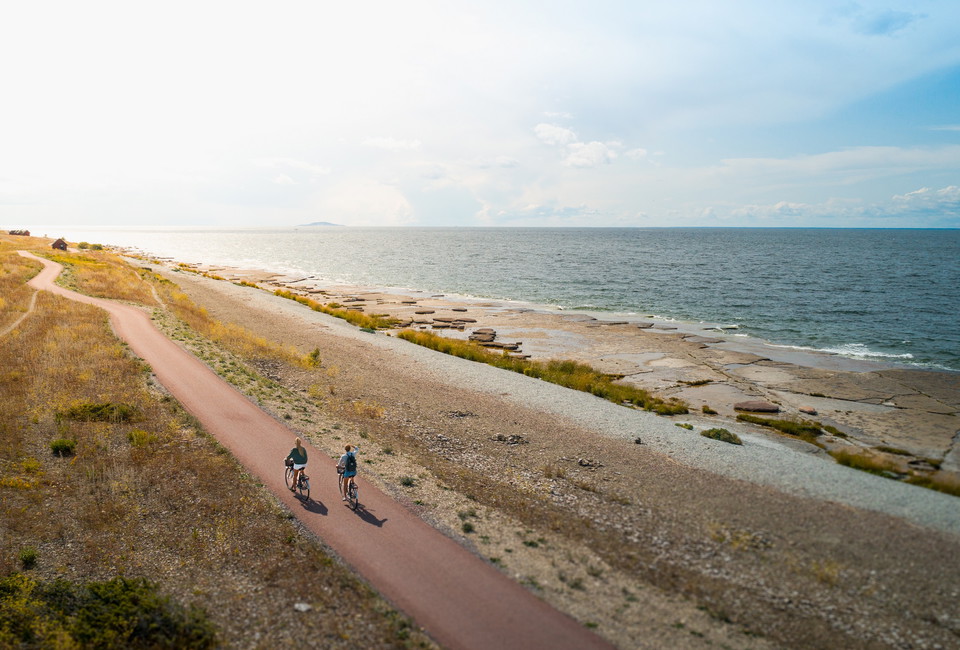
**Cycling and horseback riding in the reserve is possible on the middle road (forest road) but not on the hiking trails. There is information with a map at the parking lot and nature center.
**Dogs are welcome but must be kept on a lead throughout your stay in the reserve. This is for your own safety, the safety of the dog, the grazing animals and the wildlife. There are free-range cows in the reserve.
In early spring/early summer when the cows have been released to graze with their calves, they are often very protective and perceive dogs in particular as a threat to the calves. Remember not to bring your dog into the pasture during this sensitive time. Both for your own sake and for the cows.
Bird watching Trollskogen is a good place for bird watching at all times of the year.
**Insect collecting is not allowed as it is a nature reserve but you are welcome to look at all the species we have in the forest.
Picking up stones and parts of Swiks is also not allowed. Everything is most beautiful in situ!
The Reserve regulations are posted on the reserve sign and to read in the folder. Read through them. Otherwise, the expression 'do not disturb - do not destroy' will get you far! Welcome out!
The hiking trails
In Trollskogen there are four color-coded hiking trails. Signs show how far it is and the color shows which trail it is. It is possible to combine trails if there is something special you want to see. All trails start and end at the nature center. To plan your hike in more detail, please use our leaflet which has a map in the center spread.
Knysselnackestigen
(marked in blue) is a gravel trail of about one kilometer. It starts in the forest behind the nature center and is well suited for strollers, walkers and smaller permobiles. Manually propelled wheelchairs may need some help as some parts have height differences that are not approved from an accessibility point of view. Along the trail there is a fixed tip walk for those who want to test their skills. The first stretch goes through the forest down to the beach meadow at Grankullaviken. The beach meadow can be flooded at high tide and it follows the beach meadow and then winds along the edge of the forest towards Grankullaviken. The last bit is on the old embankment from the forest railroad. Where the trail turns onto the embankment, you can walk down to a floating dock that is used for various activities under the auspices of the nature center. The stretch to the jetty is not accessible. There are benches and picnic tables along the trail.
In the movie, you can look at the surface and the environment and decide for yourself how accessible the trail is for you.
Kolkyrkestigen
(marked green) is 1.3 km long. Kolkyrkestigen is an activity trail through the forest and along the sea. Here you will meet Morris Mård who will give you tips on activities along the trail. Have fun with Morris! Kolkyrkastigen starts at the nature center and follows the yellow and red path out to the Baltic Sea and then turns south down to the Kolkyrka dry meadow. It then turns west and back to the nature center through the forest. The trail is suitable for all generations, from children to the elderly. It is possible to get around with a pram, walker and wheelchair with an attendant. There are picnic tables at Kolkyrka and occasional benches along the trail.
In the movie you can look at the surface and the environment and decide for yourself how accessible the trail is for you.
The ivy trail
(marked yellow) is about 2.7 kilometers long and partly graveled. It is easy to get around with a pram, walker or wheelchair with an attendant. There are benches along the trail. Along this trail you can see trees completely embedded in ivy. One section runs along the shore meadows of Grankulla Bay and part of it goes through forest. You pass through the wall that is now believed to be a boundary wall for ceremonial life 2000 years ago and pass the Iron Age grave located at the southernmost end of the reserve.
Here you can look at the surface and the environment and decide for yourself how accessible the trail is for you.
Troll Forest Trail
(marked in red) is 4.5 kilometers long. The trail up to Trolleken is graveled on the east side and where it runs parallel to Murgrönestigen in the west. Before the wreck of the schooner Swiks and at Trolleken, there are graveled shortcuts back to the nature center via the middle road (forest road). Trollskogsstigen is in the northern part a nature trail where stones and roots form the surface. The whole trail takes between 1-2 hours to get around. There are benches and picnic tables along the trail. If you choose this trail, you get Trollskogens All-inclusive! It takes you around the entire cape and passes most of the sights; Trolleken, the Baltic Sea pebble beach, Iron Age tombs, the wreck Swiks, Hjerteskeppet, the wall, the windswept pines and Grankullavikens beach meadows.
Here you can look at the surface and the environment and decide for yourself how accessible the trail is for you.
See the Trollforogen nature center's films!
Here you can watch the films that naturum Trollskogen has produced in 2020 as a way to let nature come to the people when it became more difficult for our visitors to get to nature.
Activities And Facilities
- Nature reserve
Facts
Year of decision: 1998
Area: 266 hectares
Municipality: Borgholm
Landowners: Individuals and the state through the Swedish Environmental Protection Agency, the Swedish Fortifications Agency and Sveaskog
Administrator: Kalmar County Administrative Board
Directions
The reserve is located on the northeastern tip of Öland, about 65 kilometers from Borgholm. Follow road 136 north and turn towards Grankulla just before Byxelkrok. Clear signs show the way from Grankulla.
Regulations
In the nature reserve you are not allowed:
- Drive any vehicle off designated roads or trails.
- Ride horses off designated roads or trails.
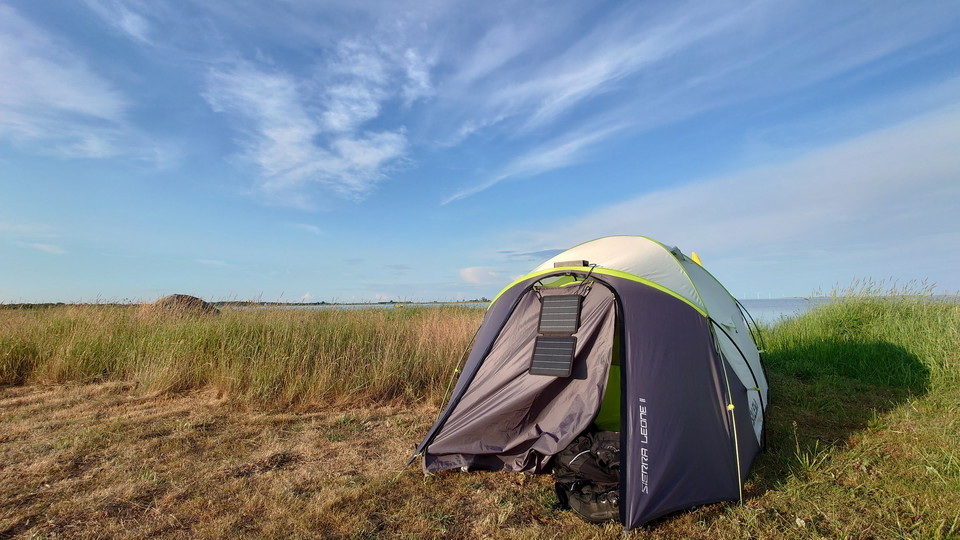
- camp.
- Build a fire.
- Bringing a dog, or other animal, that is not on a leash.
- Put up a board, sign, poster or similar device or make inscriptions.
- Damage or remove fixed natural objects or surface formations.
- Collecting loose rocks or removing pieces of bedrock.
- Damage or remove trees, bushes, stumps, bark or branches that are growing or dead.
- Digging, pulling up or picking plants or plant parts. You may pick berries and edible mushrooms.
- Climb trees with nests.
- Hunt, kill, capture or injure wild mammals, amphibians, reptiles or birds.
- Remove or damage eggs or nests.
- Deliberately disturbing wildlife.
- Mooring a buoy or anchoring permanently.
- Driving jet skis or water skiing.
If you have obtained a permit from the County Administrative Board, you may:
- Use the area for competitions or exercises.
- Carry out commercial activities.
After consultation with the County Administrative Board, you may:
- Conduct survey or research.
Full regulations
C. Regulations under Section 10 of the Nature Conservation Act on what the public must observe within the reserve.
In addition to prohibitions and regulations in other legislation, it is prohibited to:
- drive any kind of vehicle, other than on existing roads
- riding horses, other than on existing roads,
- camping
- making fires
- bring an unleashed dog or other stray pet,
- put up a board, sign, poster, poster or similar device or make an inscription
- destroy, remove or damage any fixed natural object or surface formation
- collect loose stones or remove pieces from the bedrock
- damage or remove growing or dead trees, stumps, bark, branches or bushes
- digging up or picking plants or plant parts except for berries and edible mushrooms
- climbing bamboo trees
- hunt, kill, capture or injure wild mammals, amphibians, reptiles or birds, remove or damage eggs or nests or otherwise disturb wildlife
- moor a buoy or anchor permanently
- operate jet skis or water skis,
- without the permission of the county administrative board, use the area for competition or training purposes.
- conduct commercial activities without the permission of the County Administrative Board.
Studies or research must be carried out in consultation with the County Administrative Board.
Contact
Email address
Per Markus Jönsson
Organization logotype
Please be aware that some of these texts have been automatically translated.
I’ve been here 26





I want to go here 10
Questions & Answers
Ask a question to other Naturkartan users.
Reviews
1 review
- 5 :
- 4 :
- 3 :
- 2 :
- 1 :


Riktigt härligt ställe att besöka och perfekt som familj att vandra här