
Milstenar
- Culture
- County: Jönköpings län
- 234.93 km away from you
Actions
Description
The milestone, a help when writing the travel bill
Sweden was by no means the first to use milestones. They existed in the Roman Empire and in Europe, Denmark introduced milestones in the 16th century.
It was through the 1649 Gästgivarordningen that milestones and milestones began to be set up along the country roads. The peasants had long complained about the obligation to shoot, where it was up to the common people to shoot travelers and officials. By the middle of the 17th century, this had reached levels close to the limit of what the commoners could manage.
During the time of the Great Powers, the central administration grew, which led to increased travel. The Crown now introduced allowances and travel allowances for its officials, which created a need for knowledge of distances in the country. The purpose of the milestones was to obtain reliable data for calculating travel allowances. The roads were measured from Stockholm Castle, without regard to county boundaries and residential towns. Usually a larger post was set up at every full mile, and smaller posts marking a half or quarter mile. In some places, two wooden posts were set up at full mile locations.
At first, mile posts were mostly made of wood, a relatively cheap and easily worked material. Stone posts were already in use in the 17th century, but their cost meant that they were relatively rare. It was not until around 1750 that stone started to become more common. With the development of casting technology in the 19th century, iron milestones became a cheaper alternative to stone, and in the second half of the 19th century they completely dominated milestones.
The county governors of the various counties were tasked with erecting milestones along the highways. The stone was inscribed with the monogram of the reigning king, the royal crown and 1 mile, ½ mile or ¼ mile. The name of the county governor could also be inscribed on the stone or the year when the stone was erected.
In the 1870s, Sweden switched to the meter system and in 1895 a new road law came into force. After this, no new milestones were erected. With the advent of the automobile came the need to calculate distance and time, and the new signs that were eventually erected showed distances in kilometers to selected destinations. And so it has continued.
If you drive along a road where there are milestones, you know that the road has been in the landscape for a long time. Maybe it's a road where people have been traveling for hundreds of years. Often these roads are a bit winding and not so wide, but adapted to fields and meadows, natural obstacles and located in well-drained areas. Before the automobile, there was no need for straight roads.
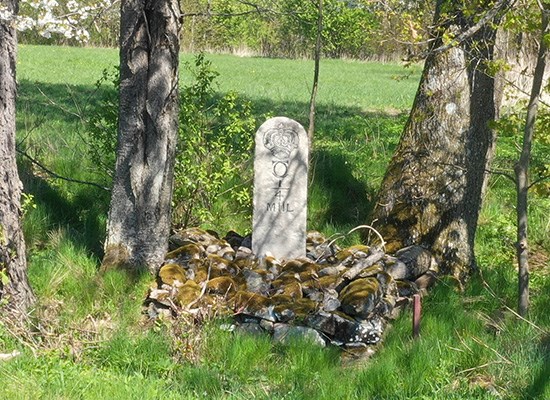
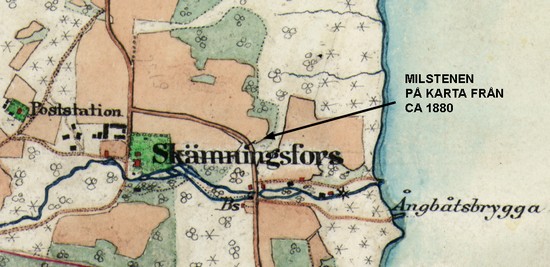
The milestone on the road between Skämningsfors and Brandstorp is a ¼ milestone, carved in sandstone and inscribed with Karl XII's crowned name cipher: "1/4 MIIL". The stone stands in a cold-walled postament. Charles XII was king between 1697 and 1718, so the stone was erected during his reign. In Fornsök the stone has the number L1972:5108.
Skaraborg County was early to provide the county with milestones. The earliest were erected in 1652. Milestones are counted as ancient remains and are protected by the Cultural Environment Act.
Activities And Facilities
- Culture
Directions
Turn left from road 195 at the sign Skämningsfors 1 km. Drive about 500 meters past the settlement and the field on the west side. Park in the small parking lot at the "No traffic" sign in the bend just where the short avenue begins. Here is the milestone on the right side of the road.
Center coordinates (SWEREF 99 TM)
N 6440819, E 453120
Contact
Email address
Kultur- och fritidsförvaltningen i Habo kommun
Organization logotype

Please be aware that some of these texts have been automatically translated.
I’ve been here
I want to go here
Questions & Answers
Ask a question to other Naturkartan users.
Reviews
0 reviews
- 5 :
- 4 :
- 3 :
- 2 :
- 1 :