
Lottes
- Culture
- County: Jönköpings län
- 236.90 km away from you
Actions
Description
Kvistrum sounds like an old name for a farm dating back to the Middle Ages, but the property you are standing on is named after Emanuel Larsson Qvist.
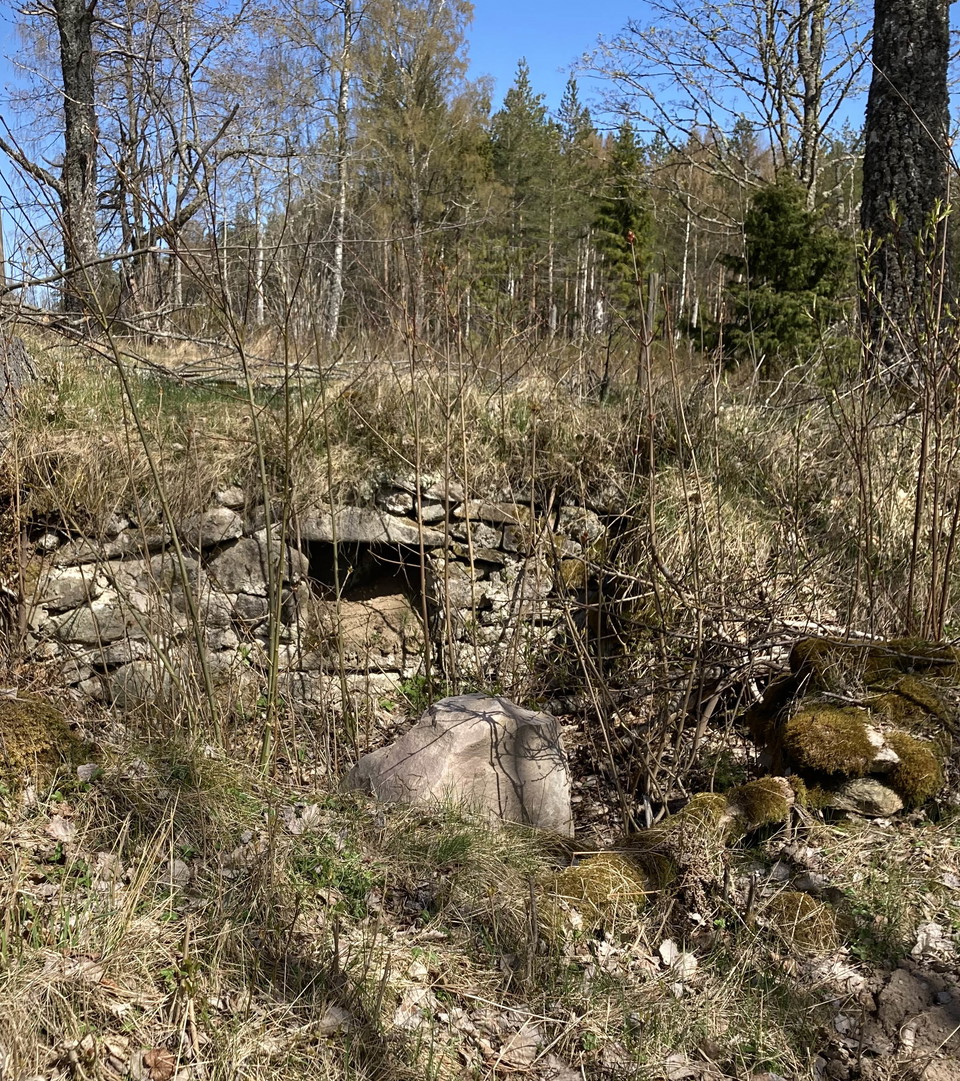
He took a small piece of the Brandstorp parish common, built an earthen ball and cultivated four acres of the barren soil in the area in the mid-19th century. He named the place after himself: Qvistrum. It says in the house hearing register that Qvist "on no one's property but on the parish common" settled here in 1853. There are still traces of the earth ball along the road (L1972:5251) in the form of a cut in a steep slope next to the road.
It may sound silly, but the name comes from the fact that the house was built by digging into a slope in order to use the earth, which was often covered with stone, as walls. The front, where the door was located, was often built in wood and an earth ball could have windows as well as a chimney. This was actually an economical way of building a small house in times of shortage of building materials. And you didn't have to build walls.
Somewhat later, a croft was built on Kvistrum's property. Presumably the Qvist family was now a little better off and could afford a more modern wooden house. On a sunny day around the turn of the century 1900, this picture was taken of the croft with its pitched roof and beautiful carpentry, but we don't know who the women are in the picture.
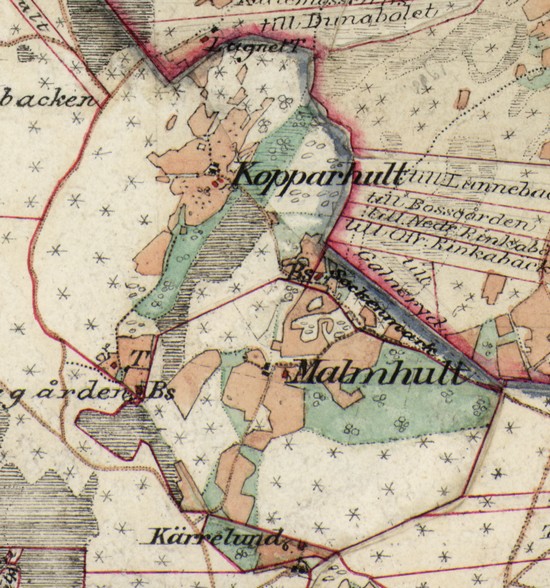
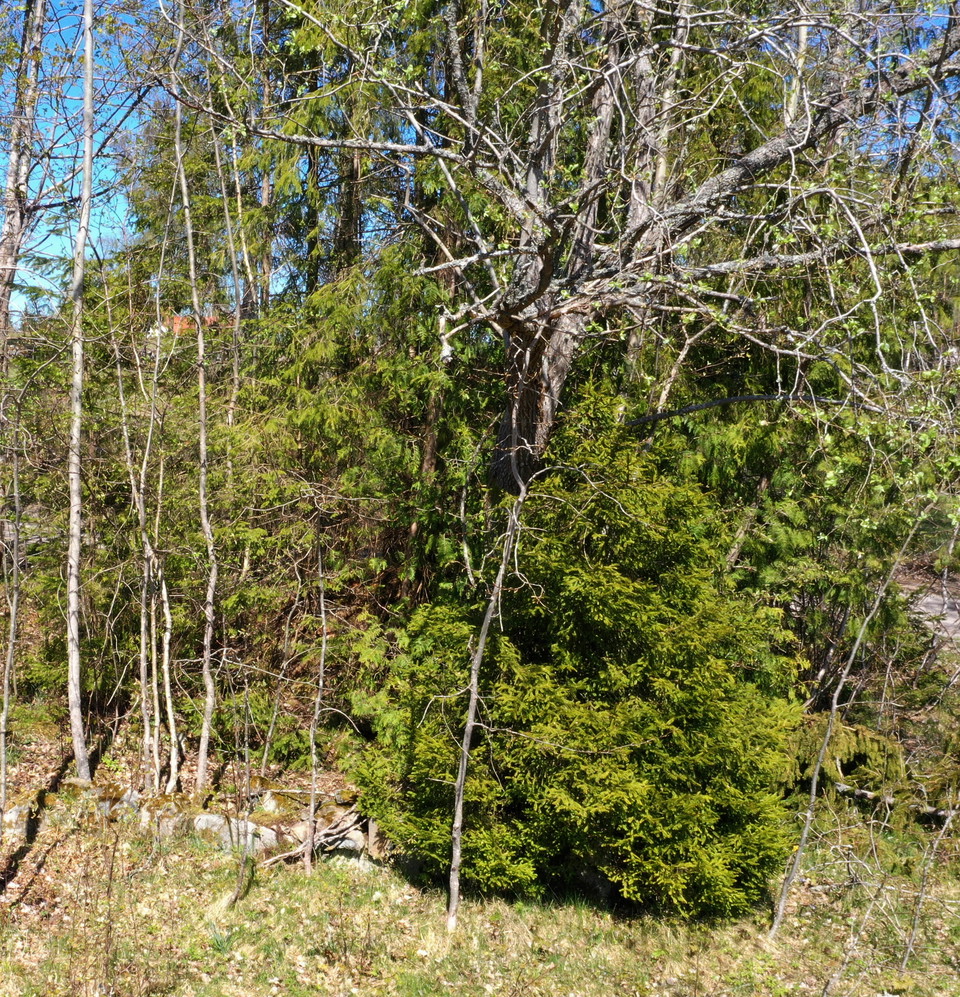
There were probably quite a few people living in the croft from the beginning, but eventually it was Emanuel's daughter Maria Charlotta Qvist who came to take over the house and the property and the croft was named Lottes after her (L1972:4594). The foundation of the house after Lottes and the cairn in the middle of the house and the basement opposite on the other side of the road do not differ much from other croft remains in Västergötland. However, the vegetation around the croft does: there are ivy and tuja, cypress and holly, unusual plants in a croft environment. We know that a gardener lived in the neighboring farm XXXX-hult and it is probably from there that Lotte bought exotic plants to decorate the croft's surroundings. This is what makes the farmstead remains so interesting, partly because we can link named people to them, and partly because of the biological cultivated diversity that we find around the farmsteads in the form of ornamental shrubs or flowers in the form of narcissi and other bulbous plants.
Over time, the name of the property was also changed from Qvistrum to Kvisthult, which is the name of the property today.
Activities And Facilities
- Culture
Directions
From road 195, turn left onto Kyrkliden and pass Brandstorp church on the right and continue into the forest after the community. Here you either turn right towards Stenshemmet or further on towards Kopparhults kvarn. After this you need to use the GPS or a map to find your way to Kvisthult (previously: Kvistrum). Pass the farms and Lotte's house grounds and cellar grounds and park at the top of the gentle slope. Here is the sign.
Along the way back down the slope you will see Lotte's cottage with basement and a little further away marks after the earth ball.
Center coordinates (SWEREF 99 TM)
N 6443880, E 449740
Contact
Email address
Kultur- och fritidsförvaltningen i Habo kommun
Organization logotype

Please be aware that some of these texts have been automatically translated.
I’ve been here
I want to go here
Questions & Answers
Ask a question to other Naturkartan users.
Reviews
0 reviews
- 5 :
- 4 :
- 3 :
- 2 :
- 1 :