
Långheds utveckling och Hässjaåns betydelse, Långhed
- Culture
- Guide
- County: Gävleborgs län
- 296.32 km away from you
Actions
Description
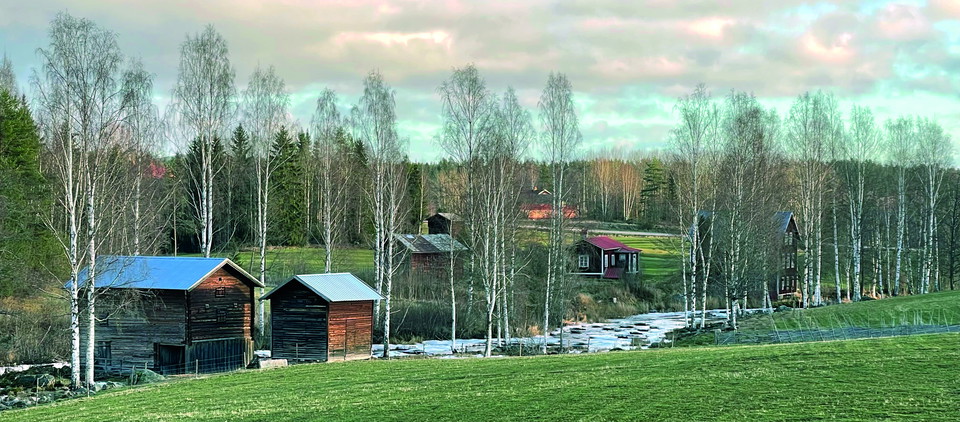
How is it that Långhed looks the way it does and that the village is located where it is? The answer is largely: Hässjaån - a place where people settled and began to farm the land. A village structure developed early along the Hässjaån and the village is mentioned as early as the 13th century under the name Longede.
In the 18th century, the government realized that agriculture had to be made more efficient in order to produce better yields. Some fields were so narrow that they could not even be turned by horse. Lantmäteriet was given the task of rationalizing and it came to be called Storskifte.
Lantmäteriet divided the arable land and pasture for each property into more coherent areas. This process started in Långhed around 1790 and is thought to have taken 10-15 years. After the Great Partition, there was no need for large meetings about what to cultivate or when to do the work. The forest was divided up in the same way, and each owner was free to farm their land.
The results of the Great Shift soon proved to be good. Production increased significantly on the land and new crops were introduced. Flax farming quickly became popular and a good source of income. In the beginning, flax was a highly manual craft, but with technological developments based on hydroelectric power, many flax mills were built. Flax became a sought-after material to be used for clothing etc.
The farmers' wealth increased and the forest could be used for their own farms or to sell timber to saws, which also led to increased construction. The village's magnificent farmhouses were built, as were many crofts and cottages. The Great Partition led to centralization as many houses were built centrally in the village. This caused problems according to the state. Lantmäteriet was therefore once again given the task of creating even better conditions for agricultural development.
The next shift came to be called Laga skifte and took place in the late 1880s. The aim was to gather and redistribute the land closer to the farming center and to break up the village cores. As a result, some properties had to be moved out, some disappeared and new ones were created.
Even today, the state still carries out compulsory land consolidation in areas where large-scale land consolidation and legal land consolidation have not been carried out, for example in Dalarna.
Here in Långhed, we see several results of these parcels of farms. Northeast of Pallars was Lars-Jons, which was moved to the other side of the river from Silfors. Southwest of our place in the pavilion was Erik-Ols, which was dissolved and the timber of the farm building was used elsewhere beyond Jon-Lars. Pell-Pers had to move and it is now in Norra Långbo, although not in its entirety. East of Pallars was Ol-Anders, which is now downstream of the Hässjåån river and has been named Anders-Pers. Other smaller properties, such as crofts and cottages, which in many cases were previously located on open ground, also had to move out.
Activities And Facilities
- Culture
- Guide
Contact
Address
Naturkartan Voxnadalen är en karta som är tänkt att samla allt för den som vill utforska Voxnadalen på egen hand. Vandringsleder, badplatser, höga naturvärden, utsikter, häftiga platser. Här samlar vi både kommunala anläggningar, ideella föreningars anläggningar (bidra gärna om ni saknas) och platser som finns på privat mark som kan vara intressanta för besökare i vårt biosfärområde. Ambitionen är att vi tillsammans bygger och bidrar till den bästa besöksguiden i Hälsingland.
Email address
Biosfärområde Voxnadalen
Please be aware that some of these texts have been automatically translated.
I’ve been here
I want to go here
Questions & Answers
Ask a question to other Naturkartan users.
Reviews
0 reviews
- 5 :
- 4 :
- 3 :
- 2 :
- 1 :