
Gravar på rad norr om Habo
- Kultur
- Landkreis: Jönköpings län
- 249.17 km von Ihnen entfernt
Aktionen
Beschreibung
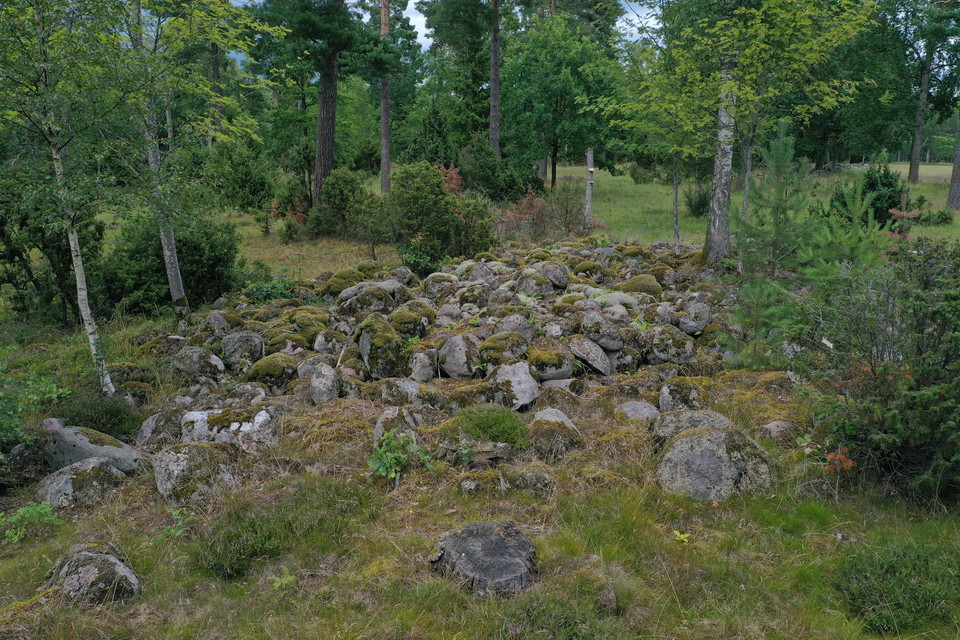
Seven graves, perhaps one per generation, have been deliberately laid out to form a line of mighty monuments
Sometime during the Bronze Age or Early Iron Age, i.e. around 1500 BC and up to a couple of centuries AD, a series of graves were built on a gently north-sloping ridge. To the south, the cut of the Hökesån river formed a steep slope, which gave the graves an even more imposing and conspicuous location on a hilltop in the otherwise fairly flat landscape.The sturdy stone settlements were erected over the dead who probably had a special rank in society, perhaps leading men and women who, through their membership of a lineage or through their skill, acquired the right to be buried in a highly visible grave. However, it is rare for graves to appear with such symmetry. In terms of size, the graves have a diameter of between 16 and 20 meters and are between half and one meter high. In a couple of the stone circles there are indications that the site had another stone circle in the middle. Over the years, such construction details have collapsed, which means that we can assume that the graves were originally much higher. Seven graves, perhaps one per generation, were deliberately placed so that they formed a line of powerful monuments. One function of the graves was to provide visible signs that the land here was used, inhabited and claimed, but we do not know how large the territory was that was claimed by the grave-travelling people.
Livestock farming was probably the basis of the economy at the time, but some arable farming was also practiced. Were there other economic activities in addition to this? Could catching and trading salmon trout from the Vättern streams have been a source of the wealth manifested in the graves? We do not know what the houses they lived in looked like and what types of crafts were practiced, as we have not yet found prehistoric building remains or activity areas in Habobygden, but we know from elsewhere that the houses during the Bronze Age were oblong and two-storeyed, with walls of wood or clay-lined wickerwork and that the roofs were steep and covered with reeds or other water-repellent material.
It is likely that a road ran close to the graves as they would be seen by travelers. The graves probably had other important signal values for Iron Age people, but we do not know what these were.Further west and closer to Habo village there is a burial ground that has also been selected as one of the municipality's visitor destinations, namely L1972:5026 or Kråkerydsgravfältet. There, the grave forms are of a completely different character and consist of stones or blocks set in circles. In terms of time, the Kråkeryd cemetery is younger than the eight stone settlements and possibly we see a chronological stratification in burial conditions within the group or groups that owned the power and claimed the land north of what is today Habo community.
Aktivitäten und Einrichtungen
- Kultur
Anleitung
Straßenbeschreibung
Parkplatz in der Parktasche nördlich des nördlichen Eingangs von Habo neben L1972:4254. Die Straße 195 ist stark befahren, aber wenn man eine Lücke bekommt, kann man auf die andere Seite laufen, wo sieben der acht Gräber liegen. Vielleicht können Sie auch in den Süden kommen und an der Straße zum Klingekärrer Bauernhof einbiegen. Etwa 150 Meter nördlich der Grablinie gibt es die Möglichkeit, in eine Waldstraße zu schwingen und die kurze Straße zu den Gräbern zu schlendern.
Center coordinates (SWEREF 99TM)
N 620814, E 446373
Kontakt
E-Mail-Adresse
Kultur- och fritidsförvaltningen i Habo kommun
Logotyp der Organisation

Bitte beachten Sie, dass einige dieser Texte automatisch übersetzt worden sind.
Ich bin hier gewesen
Ich möchte hierher gehen
Fragen & Antworten
Stellen Sie eine Frage an andere Naturkartan-Nutzer.
Bewertungen
0 Rezensionen
- 5 :
- 4 :
- 3 :
- 2 :
- 1 :