
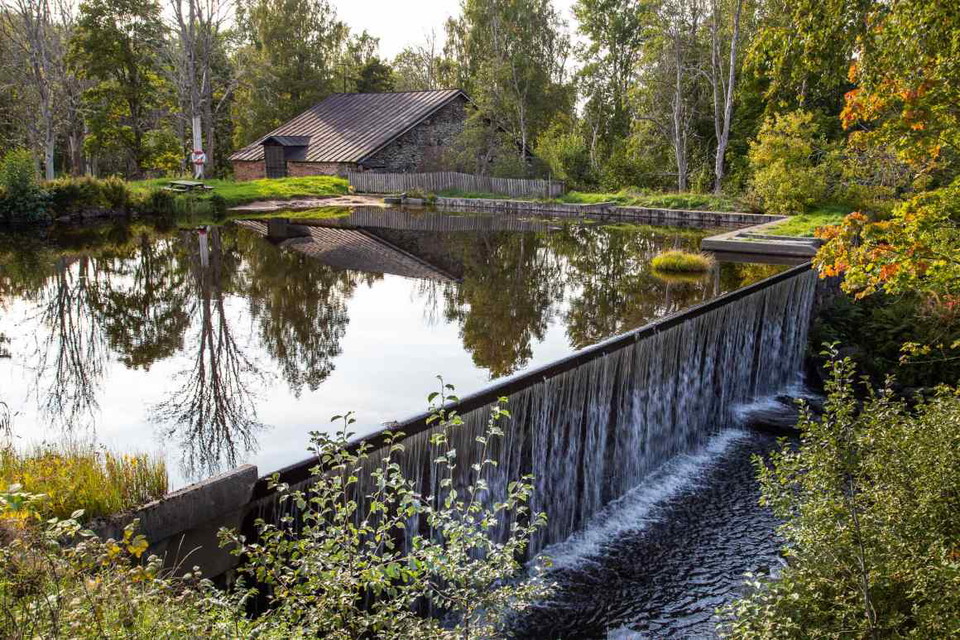
Klosters bruk
- Kultur
- Wertvolle Natur
- Nähe eines Parkplatzes
- Parken
- Sehenswürdigkeit
- Landkreis: Dalarnas län
- 191.21 km von Ihnen entfernt
Aktionen
Aktivitäten und Einrichtungen
- Kultur
- Wertvolle Natur
- Parken
- Sehenswürdigkeit
Zugänglichkeit
- Nähe eines Parkplatzes
Fakten
Iron and copper smelting works were established on the Klosterån river as early as the 15th century. The site was originally called Riddarhyttan, but was named Kloster after a Cistercian monastery was founded here in 1486. In connection with King Gustav Vasa's reduction, the monastery was transferred to the Crown in 1527. Today, only the foundations of the monastery church remain.
In addition to iron production, gunpowder was also manufactured in the monastery from the mid-17th century. By the mid-18th century, gunpowder production had grown to become Sweden's largest gunpowder factory. The engineer and inventor Gustaf de Laval was employed at the factory's forge in 1876-77. Here he designed a milk separator that became a success on farms all over the world.
In 1888, poor communications and recession led to the mill's closure. The ruins and remains that can be seen on the site today are the only visible traces of the centuries-old industrial activity that took place in Klosters Bruk.
Anleitung
Das Gebiet liegt 15 km nordöstlich von Hedemora. Fahren Sie den Weg 270 Richtung Husby. Fahren Sie mehr als 1 km auf der Straße, die wieder nach Süden dreht und Dalälven folgt. Links nach Kloster und Dormsjö. Sie kamen nach etwa 3 km an.
Kontakt
Adresse
Telefon: 0225-340 00
E-Mail-Adresse
kommun@hedemora.se
Bitte beachten Sie, dass einige dieser Texte automatisch übersetzt worden sind.
Ich bin hier gewesen
Ich möchte hierher gehen 1

Fragen & Antworten
Stellen Sie eine Frage an andere Naturkartan-Nutzer.
Bewertungen
0 Rezensionen
- 5 :
- 4 :
- 3 :
- 2 :
- 1 :